Before you leave, let our managing team review your rigid box project. Share your product type, target market quantity, and launch timeline, and well heip evaluate the best structure, material, finish, MOQ, ond production plan for your brand
Get Sales & Packaging Engineering Support
Our Sales Team
Need help with magnetic closure boxes, lid lift-off boxes, drawer boxes, cosmetic boxes, candle boxes, perfume boxes, tea boxes, wine boxes, or promotional packaging? Send us your requirements and our sales or engineering team will help with pricing, structure, sampling, printing, anda production feasibility.
How Are Cardboard Tubes Made? A Step-by-Step Manufacturing Guide
Stand beside a tube-winding line and, at first, there isn’t much drama. Brown paper ribbons disappear under a moving belt. A cylinder creeps along a polished steel shaft. Somewhere downstream, a saw snaps into action.
Table of Contents
Done. Apparently.
Except it isn’t, because the cardboard tube manufacturing process is really a prolonged wrestling match between paper tension, glue viscosity, winding geometry, belt pressure, moisture, cutting accuracy and the inconvenient fact that paper can change shape after everyone thinks production is over.
How are cardboard tubes made, then?
Kraft paper or recycled paperboard is slit into narrow ribbons. Adhesive goes onto the plies. The strips are wound around a steel mandrel, usually in a spiral, until they form a continuous laminated tube. That body is cut, dried, trimmed, wrapped, fitted with closures and inspected.
That’s the short answer.
The useful answer—the one procurement teams need before signing off a 20,000-piece order—is considerably less tidy.
No, Cardboard Tubes Aren’t Rolled-Up Shipping Cartons
This misconception refuses to die.
Most cardboard tubes aren’t made from corrugated board. There’s usually no fluted medium sandwiched between liners, as you would find in a shipping carton. The tube wall is built from multiple solid paper or paperboard plies bonded together around a cylindrical mandrel.
Each ply earns its place:
The inside liner provides a cleaner bore and manages friction against the mandrel.
Structural plies build wall thickness, stiffness and crush resistance.
The outer wrap carries the artwork and tactile finish.
Barrier materials may help manage grease, odor or moisture.
A shoulder, end disc, cap or plug closes the package.
So the tube is really a laminated paper structure. Not just “thick cardboard.”
That distinction matters when comparing it with other types of custom paper packaging. Folding cartons obtain much of their form from panels, scores and corners. A tube depends on bonded plies, cylindrical geometry, seam placement and wall consolidation.
Here’s the ugly truth: bad tube winding stays bad, no matter how much foil gets stamped over it. A soft-touch wrap may distract the eye for ten seconds, but it won’t repair delamination, a crushed rim or a body that rolls like an egg.
Structural plies commonly use kraft paper, recycled paperboard or a blend of both. Kraft grades typically contain longer fibers and can deliver strong tensile performance. Recycled board can perform well too, though its properties may fluctuate more between mill lots.
Buyers are often given one familiar number: GSM.
Useful? Yes.
Sufficient? Not even close.
GSM means grams per square metre. It tells you the paper’s mass per unit area. It doesn’t tell you whether a finished tube will resist side pressure, support a stacked load or keep its cap fitted after six weeks in humid ocean freight.
Tube performance also depends on:
Fiber composition
Number of plies
Ply order
Wall thickness
Winding angle
Seam offset
Adhesive application
Residual moisture
Tube diameter
Unsupported length
A thick tube can still be weak. If the plies aren’t properly bonded—or if several spiral seams stack directly above one another—the wall may split long before a thinner, better-engineered construction does.
More board isn’t engineering.
Glue: invisible, wet and frequently blamed too late
PVAc, dextrin and starch-derived water-based adhesives are common in paper converting. The correct formulation depends on paper porosity, winding speed, required open time, factory temperature, drying conditions and expected storage humidity.
Glue weight needs control.
Too little leaves dry bond lines and lifting plies. Too much soaks the wall, extends drying time, stains the outer sheet and may push excess adhesive from the spiral seam. Operators call this squeeze-out. Buyers call it a defect.
Both are right.
But the adhesive doesn’t work alone. A cold paper reel may behave differently from a warm one. Recycled board from one lot may absorb faster than the previous batch. Increase the winding speed without adjusting the glue delivery and application weight can drift.
That’s why the phrase “eco-friendly glue” irritates me. It sounds responsible while dodging every useful question: Which chemistry? What solids content? Which compliance documents? What contact conditions? What resistance to heat and moisture?
Get the paperwork.
Paper Tube Boxes
Liners and wraps do more than look pretty
The brown structural tube may disappear completely beneath its finishing materials. Common choices include:
Coated art paper
Natural kraft paper
Dyed-through paper
Textured specialty stock
Printed white paper
Metallized paper
Film-laminated sheets
Glassine liners
Grease-resistant paper
Selected foil-and-paper barriers
Then the decoration starts—offset printing, flexography, hot foil, screen printing, embossing, debossing, spot UV, matte film or soft-touch lamination.
And every finish brings baggage.
Dense black ink shows scratches. Natural kraft alters printed color. Soft-touch film collects handling marks. Deep embossing can disturb wrapping pressure. Foil placed close to a rolled edge may crack.
Pretty gets technical fast.
The Cardboard Tube Manufacturing Process, Without the Sales Gloss
1. The packaging idea becomes a production recipe
“Same as the photo, but slightly larger” isn’t a specification. It’s an invitation to argue later.
Before production, the manufacturer needs to establish:
Internal diameter
External diameter
Wall thickness
Finished length
Dimensional tolerances
Closure construction
Product dimensions and weight
Insert design
Printing method
Surface finish
Strength expectations
Shipping and storage conditions
The mandrel generally controls the tube’s inside diameter. Structural plies and decorative materials build outward from it.
Obvious, right?
Yet buyers routinely submit exterior measurements while the product itself must fit inside. Once wall thickness and an inner liner are added, the usable opening becomes smaller than expected.
A telescoping tube is less forgiving. The lid and lower body must slide together without binding, dropping off or trapping so much air that opening the package feels like pulling a piston from a cylinder.
Fractions matter here.
White Rigid Window Cylinder Box for Candle Jar Packaging
2. Large paper rolls are slit into narrow ribbons
Master reels enter a slitting machine, where rotary knives divide the web into narrower strips. Their width is chosen according to tube diameter, desired winding angle and ply arrangement.
The cut edge needs to be clean.
A dull knife produces fiber fuzz—sometimes called paper hair—plus dust and ragged edges. Those little fibers can interfere with bonding or create a raised line beneath the outer wrap.
Web tension needs watching too. Too much tension stretches or curls the strip. Too little lets it wander, wrinkle or feed into the winding head inconsistently.
The defect may begin here and appear three stations later.
Annoying, but common.
3. Adhesive is applied to the structural plies
Next, the ribbons move through a gluing station. Rollers, cascade systems or metered applicators spread adhesive across the relevant paper surfaces.
The target isn’t “lots of glue.” It’s a controlled film.
Dry spots can become loose plies. Heavy spots introduce unwanted water. Dirty transfer rollers leave stripes. Poor edge coverage opens the spiral seam. When machine speed changes, glue delivery may also need adjustment to maintain a consistent coating weight.
However, visual inspection alone won’t prove the bond is good. A wet tube can look perfectly acceptable while the plies are still moving, swelling and settling.
Give it a bend later. Then you find out.
4. The ribbons meet the spiral-winding mandrel
Here comes the part people film.
Several glue-coated paper strips enter a stationary steel mandrel at predetermined angles. A driven winding belt wraps around the forming tube, compresses the plies and pulls the new cylinder forward in one continuous helical motion.
It works quickly.
But because ribbon angle, belt pressure, web tension and adhesive tack must stay balanced while the tube moves along the mandrel, a small setup error can travel through hundreds of bodies before an operator notices that the seam has drifted or the tube has gone out of round.
Aligned ply seams form a weak path through the wall.
That last point deserves attention. The individual spiral seams should be staggered. Stack them on top of one another and you’ve effectively drawn a break line through the laminate.
Spiral winding dominates high-volume cardboard tube production because it’s continuous and efficient. Convolute winding is different: a sheet wraps around the mandrel in overlapping turns. It can suit short tubes, heavy walls or particular cosmetic requirements.
Which is better?
Wrong question. Diameter, length, appearance, production quantity and load requirements decide that—not a generic ranking on a supplier’s website.
5. A traveling cutter chops the continuous body
As the newly wound tube advances, a flying saw or rotary cutting unit moves with it and separates the endless cylinder into shorter bodies.
Often, this is only a rough cut.
A small allowance may be left for final trimming after the tube dries. That extra operation costs time, but it allows more accurate finished lengths and cleaner edges.
Blade condition matters. A blunt blade can crush the wall, drag the wrap, create dust or leave a visibly slanted end. Put a lid onto that cut and it sits crooked.
Small defect. Cheap-looking result.
6. The fresh tubes dry—and sometimes misbehave
Wet glue means wet paper. Freshly wound tubes therefore need time, airflow and appropriate temperature to settle into stable dimensions.
Rush this stage and the tube may punish you later.
It can shrink. It can bow. It can become oval. Plies may lift. A cap fitted while the body is damp can loosen after drying, while a tight sleeve may become even tighter if moisture conditions change again during storage.
There’s no single correct drying time.
Wall thickness, paper absorbency, adhesive solids, ambient relative humidity and airflow all affect the result. A lightweight cosmetics tube isn’t going to dry like a thick industrial winding core.
Anyone giving one universal number without seeing the tube recipe is guessing.
7. Bodies are trimmed and the raw edges are dealt with
After conditioning, the tube is precision-cut to its final length. Depending on the design, the manufacturer may sand, curl, roll, cover or reinforce the ends.
On retail packaging, the customer sees everything:
Exposed greyboard
Glue marks
Frayed fibers
Tilted cuts
Uneven rolled edges
Misaligned seams
Crushed rims
A cap may conceal the raw edge, but that doesn’t mean the edge can be ignored. Rough fibers can scratch a sachet, catch on fabric or shed particles inside the package.
Looks fine closed.
Open it five times, though, and the weakness begins to show.
8. Graphics, wraps and surface finishes are applied
The outer artwork may be printed before wrapping, added as a label or printed directly onto the tube after forming. Preprinted sheets provide more decorative freedom, but curved surfaces make registration less forgiving.
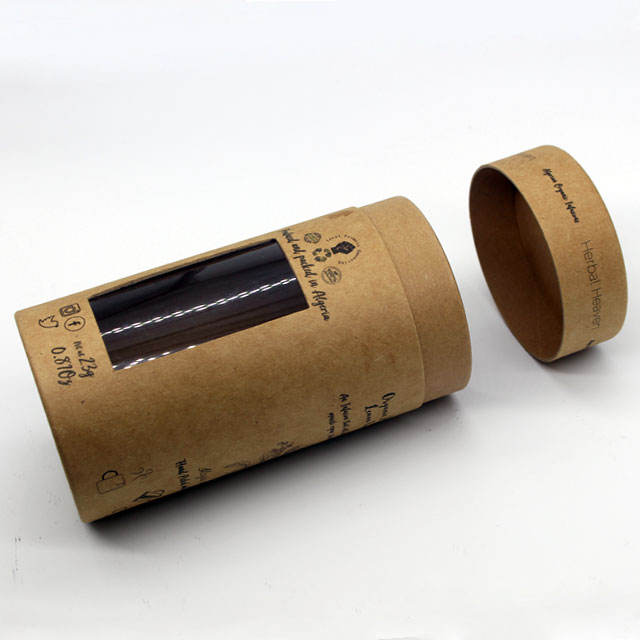
Consider a printed kraft window tube for organic henna packaging. The printed wrap, viewing window, closure and filled product all need to line up. Shift one component by 3 mm and the window may frame an empty space or reveal the edge of an internal label.
Kraft paper complicates color approval as well. A Pantone shade printed on white proofing stock won’t look identical on brown, porous paper. An opaque white base can improve color accuracy—but it adds another ink pass, another registration variable and more cost.
Black soft-touch tubes are another favorite. They look terrific under controlled photography.
Then real hands touch them.
Fingerprints, rub marks and pale scuffs become far more noticeable on deep matte surfaces. Tissue wrapping, individual bags or dividers may reduce the damage, although each option changes labor, material use and packing density.
9. Caps, shoulders and inserts turn the body into packaging
A naked tube is only the beginning.
Possible components include:
Paperboard end discs
Friction-fit paper caps
Telescoping lids
Internal shoulders
Rolled-edge closures
Metal plugs
Plastic plugs
Pull tabs
Windows
Paperboard inserts
Molded-pulp trays
EVA foam
Thermoformed PET
A two-piece rigid paper tube with a thumb window illustrates the tolerance problem nicely. Body diameter, sleeve diameter, paper thickness and notch position all affect whether the lid opens smoothly.
Too tight and the customer wrestles with it.
Too loose and it rattles.
The insert presents another argument. Molded pulp provides shaped fiber-based support. Folded paperboard is printable and relatively easy to flatten. EVA holds products neatly but introduces foam. Thermoformed PET provides precise cavities and visibility, though consumers may need to separate it from the paper body.
But should every tube have a plastic window, metal ring and foam cradle merely because the structure permits it?
I frankly believe the answer is no.
The European Parliament’s April 2024 packaging rules agreement set packaging-reduction targets of 5% by 2030, 10% by 2035 and 15% by 2040. Brands selling into Europe should review unnecessary void space and mixed-material accessories before approving tooling.
Afterward is expensive.
10. Finished tubes are checked—or waved through
“QC passed” looks reassuring on an inspection sheet. By itself, it means nothing.
Checked against what?
A useful inspection plan can include:
Internal and external diameter
Body length
Wall thickness
Roundness
Ovality
Straightness
Edge squareness
Spiral-seam position
Ply adhesion
Axial compression
Radial crush resistance
Cap removal force
Print registration
Color tolerance
Scuff resistance
Insert retention
Moisture condition
Odor
Filled-pack drop performance
And don’t inspect only empty tubes. The product changes the package completely.
A glass bottle drives force into the base during a drop. A heavy jar can spread an insert. Powder may contaminate a friction-fit closure. Oil can attack an unsuitable liner. A nearly airtight lid may become harder to open when pushed down quickly.
Test the real pack.
Not the pretty shell.
Printed Kraft Window Tube Box for Organic Henna Packaging
Spiral-Wound, Convolute, and Composite Tubes Compared
Tube construction
How it is formed
Main advantages
Main limitations
Typical applications
Spiral-wound tube
Narrow paper ribbons are wound helically around a mandrel in a continuous process
Fast production, efficient material use, long continuous bodies, wide diameter range
Visible spiral seams; setup depends heavily on tension and angle control
Retail packaging, mailing tubes, film cores, labels, textiles
Convolute-wound tube
A sheet is wrapped around the mandrel in overlapping layers
Smooth appearance, controlled seam placement, suitable for thick or short bodies
Catalog categories can be fuzzy. Production specs can’t.
Recycling Data: Useful Numbers, Awkward Caveats
Paper tubes begin with a genuine advantage: established paper-recovery infrastructure.
Still, “paper based” isn’t a magic recycling spell.
The American Forest & Paper Association’s 2024 paper recycling report says approximately 46 million tons of paper were recycled in the United States during 2024—about 125,000 tons per day. Its estimated paper recycling rate was 60%–64%, while cardboard reached 69%–74%.
U.S. mills used 1.3 million more tons of recycled paper in 2024 than in 2023. Cardboard accounted for 1.2 million tons of that increase, and about 20.8 million tons of recovered paper went into containerboard.
Strong system. Messy product-level reality.
Those national figures don’t prove that one particular luxury tube will be recycled. A clean fiber body with a removable paper cap is fairly straightforward. Add permanent plastic film, a metal bottom, a PVC window and a black foam insert—and the claim needs far more qualification.
The EU’s regulatory direction reinforces the point. The official text of Regulation (EU) 2025/40 says packaging consumes 50% of the paper used in the European Union and represents 36% of municipal solid waste.
That’s difficult to brush aside.
My opinion? Paper tubes make their best environmental case when the design team shows restraint. A recyclable paper shoulder and folded-board insert may appear less theatrical than a metal collar and dense foam cradle, yet the simpler construction is easier to explain, separate and recover.
Boring can be smart.
Where Cardboard Tubes Fail in the Real World
Humidity changes the fit
A perfectly fitted cap in a climate-controlled sample room may jam after the paper body absorbs moisture in transit. Or the tube dries, contracts slightly and leaves the lid loose.
Paper moves.
That’s why measurements should be tied to conditioning conditions—not treated as numbers floating in space.
Side pressure creates oval bodies
Cylinders handle distributed loads efficiently. Concentrated side pressure is different.
Tight stretch wrapping, poorly sized export cartons, excessive headspace or uneven pallet stacking can deform the retail tubes. Some recover. Others stay oval, especially if humidity has already softened the wall.
The master carton is part of the design, even if it never reaches the consumer.
Matte wraps scuff before they reach the shelf
Deep colors, uncoated papers and soft-touch surfaces can show contact abrasion quickly. Tube against tube, carton vibration, a little paper dust—suddenly the black finish has pale rings around it.
Factories may add tissue, bags or partitions. Fine. But those fixes affect cost, plastic use, labor and carton efficiency.
Choose deliberately.
Closures fail only after filling
Empty-package fit checks can miss the real failure mode. During a drop, the packed product loads the base, insert and lid. A heavy bottle may punch through a weak disc or knock an internal shoulder loose.
The empty sample survives.
The sellable product doesn’t.
What Buyers Should Put in the Tube Specification
Photos help. Measurements decide.
A serious RFQ should include:
Internal diameter and tolerance
External diameter or finished wall thickness
Finished body length
Cut-squareness requirement
Structural-paper grade and GSM
Recycled-content or fiber-certification requirements
Adhesive restrictions
Inner-liner material
Outer-wrap material
Artwork and Pantone references
Printing process
Surface finish
Cap material and fit
Target cap-removal force
Insert construction
Product dimensions and filled weight
Storage temperature and humidity
Shipping destination and transport method
Required package tests
Inspection level and acceptance limits
Add an approved physical sample too. A “golden sample” gives production and inspection teams something concrete to compare.
Digital renders won’t reveal odor, opening force, surface friction or glue residue. Screens can’t tell you whether the cap squeaks. And no 3D mockup has ever shown how a tube feels after sitting in a humid warehouse for four weeks.
Paper doesn’t care about the render.
White Rigid Jewelry Tube Gift Box with Cotton Rope Handle
FAQs
How are cardboard tubes made?
Cardboard tubes are made by coating narrow paperboard ribbons with adhesive and winding several plies at controlled angles around a steel mandrel, after which the continuous laminated body is cut, dried, precision-trimmed, decorated, fitted with closures or inserts, and inspected for dimensions, roundness, bonding and mechanical performance.
Most high-volume packaging tubes use spiral winding. Convolute winding suits selected short, thick or cosmetically demanding bodies.
What is the difference between a cardboard tube and a paper tube?
A cardboard tube and a paper tube normally describe the same wound-fiber cylinder, although “paper tube” is the broader technical term because the body can combine kraft paper, recycled paperboard, specialty liners and decorative wraps instead of the fluted corrugated material used to make conventional shipping cartons.
“Fiber tube,” “paper core” and “paper can” are also common. The preferred term often depends on the application.
What is spiral winding in cardboard tube production?
Spiral winding is a continuous manufacturing method in which several adhesive-coated paper ribbons enter a steel mandrel at calculated angles, overlap in helical paths and are compressed by a driven winding belt, forming a laminated cylinder that moves forward along the mandrel before being cut into required lengths.
The ply seams should be staggered. Aligning them can create a weak path through the tube wall.
Which adhesive is used to manufacture paper tubes?
Paper-tube manufacturers commonly use water-based PVAc, dextrin, starch-derived or specially formulated industrial adhesives selected according to paper porosity, winding speed, required open time, drying conditions, storage humidity, bond-strength targets and any chemical or food-contact requirements applying to the packed product and destination market.
Don’t assume “water based” means food safe. Request documentation for the exact adhesive and intended contact condition.
How long does a cardboard tube take to dry?
Cardboard-tube drying time is the period needed for adhesive moisture to leave the laminated wall and for the paper body to reach stable dimensions, but the actual duration varies with wall thickness, paper absorbency, adhesive solids, airflow, temperature, relative humidity, production speed and the drying equipment used by the factory.
One universal drying time isn’t credible. Finished stability should be confirmed by measurement after conditioning.
Are cardboard tubes recyclable?
Cardboard tubes are generally compatible with paper-recovery systems when they are empty, clean, predominantly fiber based and accepted by the local collection program, although bonded plastic films, metal ends, foam inserts, barrier laminates, product contamination or other inseparable components may reduce acceptance or require separation before recycling.
Local recycling rules control the final answer. Brands should identify any caps, windows or inserts that need removing.
How strong is a spiral-wound paper tube?
A spiral-wound paper tube’s strength depends on diameter, wall thickness, paper grade, fiber quality, ply sequence, seam offset, adhesive bond, moisture content, winding pressure, unsupported length and loading direction, meaning two tubes with identical outside dimensions can produce very different axial-compression, radial-crush and bending results.
Test against the actual load case. A gift tube isn’t an industrial winding core.
What causes a cardboard tube to become oval?
Cardboard-tube ovality is a loss of circular shape caused by uneven winding tension, unstable belt pressure, excessive adhesive moisture, incomplete drying, mandrel or cutting problems, weak wall construction, concentrated side loading, poor export packing, or exposure to high relative humidity during storage and long-distance transportation.
Measure it after conditioning. A reading taken straight from the machine may hide the later movement.
Can cardboard tubes be printed directly?
Cardboard tubes can be decorated through direct printing, labels or preprinted outer wraps, with the suitable method depending on order volume, artwork detail, color standards, tube diameter, surface texture, seam visibility and finishing requirements such as foil stamping, embossing, matte lamination or spot UV coating.
Preprinted wraps offer greater graphic flexibility. Direct printing still requires curved-surface registration and ink-adhesion checks.
What information does a manufacturer need to quote paper tubes?
A manufacturer needs the tube’s internal diameter, external diameter or wall thickness, length, quantity, structural materials, cap type, artwork, surface finish, insert design, packed-product dimensions and weight, tolerances, destination market, test requirements, and any fiber-certification, restricted-substance or food-contact documentation required for production.
Send a product sample and dimensional drawing when possible. Photographs alone leave too much room for assumptions.
Turn the Tube Concept Into Something a Factory Can Repeat
Start with fit.
Then deal with wall construction, product weight, closure behavior, insert retention, humidity exposure and the export carton. Artwork comes after those decisions—not because artwork is unimportant, but because a gorgeous tube that jams, deforms or sheds its base is still a failed package.
Send Chengyi Packaging the product dimensions, filled weight, required tube diameter, preferred closure, artwork, quantity, destination market and desired finish. The structure can then be reviewed for manufacturability before tooling and mass production.