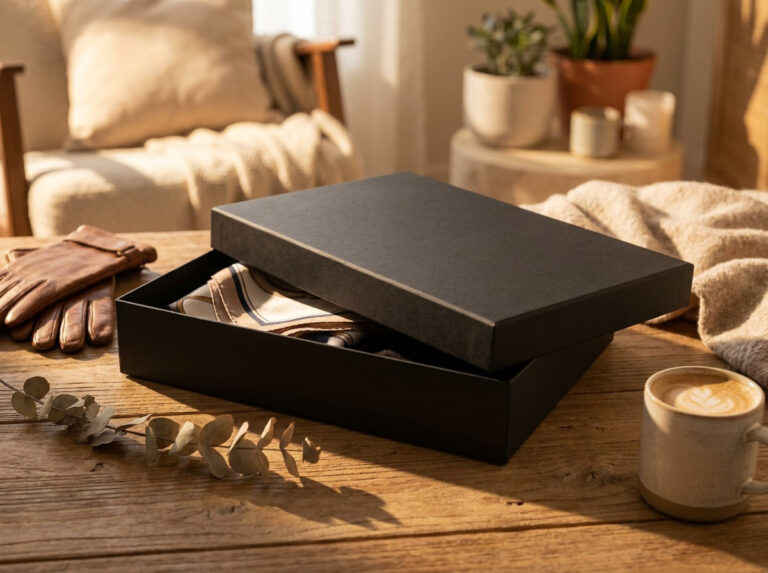
Before you leave, let our managing team review your rigid box project. Share your product type, target market quantity, and launch timeline, and well heip evaluate the best structure, material, finish, MOQ, ond production plan for your brand
Get Sales & Packaging Engineering Support
Our Sales Team
Need help with magnetic closure boxes, lid lift-off boxes, drawer boxes, cosmetic boxes, candle boxes, perfume boxes, tea boxes, wine boxes, or promotional packaging? Send us your requirements and our sales or engineering team will help with pricing, structure, sampling, printing, anda production feasibility.
What Are the Different Types of Wine Packaging? A Complete Guide
A wine buyer once described packaging to me as “the bottle, plus whatever goes around it.”
Fair enough. Also dangerously incomplete.
By the time a bottle reaches somebody’s kitchen table, it may have endured case packing, pallet pressure, two warehouses, humid ocean air, conveyor impacts, a delivery van with tired suspension, and one careless drop onto concrete. That gold foil logo? It won’t help.
Glass breaks. Fast.
Wine packaging actually works across three layers. Primary packaging holds the liquid. Secondary packaging protects or presents the bottle. Tertiary packaging gets cases through freight networks without turning a shipment into an expensive box of merlot-scented glass shards.
And yes, those layers overlap. A bag-in-box shell presents the wine and supports the inner bladder. A wooden case can be both a gift package and a transport container. A rigid box might look protective but still require a proper corrugated overpack.
That last one catches people out.
Here’s the ugly truth: packaging projects often begin with Pantone colours, ribbon samples, and foil swatches when they should begin with a scale, a calliper, the actual bottle, and a blunt question—where is this package going to be kicked around?
Table of Contents
Wine Packaging Types Explained by Function
What counts as wine packaging? More things than most buyers expect.
Glass bottles, PET bottles, aluminium cans, flexible pouches, aseptic cartons, and bag-in-box systems hold the product. Folding cartons, rigid boxes, paper tubes, and wooden cases handle presentation. Corrugated shippers, molded pulp trays, partitions, and foam inserts try to prevent damage.
Try being the operative word.
Packaging type
Packaging level
Typical capacity or format
Main advantage
Main weakness
Best-fit application
Glass bottle
Primary
187 mL–3 L
Strong oxygen barrier and premium familiarity
Heavy, fragile, freight-intensive
Traditional retail and cellaring
PET bottle
Primary
187 mL–1.5 L
Lightweight and impact-resistant
Shorter perceived or technical shelf-life limits
Events, travel, rapid-turnover wine
Aluminium can
Primary
187–375 mL
Portable, light-blocking, single-serve
Consumer resistance in premium categories
Outdoor and convenience markets
Bag-in-box
Primary and secondary
1.5–20 L
Efficient dispensing and low packaging weight per litre
Limited luxury positioning
By-the-glass and household consumption
Flexible pouch
Primary
187 mL–1.5 L
Very low empty-pack weight
Puncture and recycling complications
Travel and casual occasions
Folding carton
Secondary
One or multiple bottles
Printable and economical
Limited structural protection alone
Retail sleeves and multipacks
Rigid paperboard box
Secondary
One to three bottles
Premium presentation and strong branding
Higher unit and freight cost
Gifting and limited editions
Paper tube
Secondary
Usually one bottle
Distinctive cylindrical presentation
Requires a secure base and neck restraint
Premium gifting and spirits-style presentation
Wooden box or crate
Secondary/tertiary
One to twelve bottles
High perceived value and rigidity
Heavy and space-consuming
Collectors, gifting and export cases
Corrugated carton
Tertiary
Commonly 1, 3, 6 or 12 bottles
Efficient shipping protection
Appearance can feel industrial
E-commerce and wholesale distribution
Molded pulp insert
Protective component
Custom cavities
Stable, paper-based cushioning
Tooling and fit validation required
Shipping and sustainable gift packs
I frankly believe the phrase “best wine packaging” causes more confusion than it resolves. Best for what—cellaring, courier shipping, retail theatre, portion control, low freight weight, or a corporate gift that must look impressive in a boardroom?
A $15 supermarket wine and a $250 vintage release may both use 750 mL bottles. Their packaging economics aren’t remotely similar.
Custom Wine & Spirits Boxes
Glass Bottles Still Dominate—and Still Cause Trouble
Conventional glass wine bottles
Glass has earned its position. It doesn’t react readily with wine, offers an excellent gas barrier, works on established filling lines, and supports cork, synthetic closure, and screw-cap systems.
Consumers know it, too.
The weight, punt, shoulder profile, glass colour, closure and label all communicate something before the wine is opened. A tall Alsace bottle feels different from a broad Burgundy bottle. Heavy glass still signals “premium” to plenty of buyers, even when the environmental logic looks questionable.
But let’s not romanticise it. Glass is heavy, brittle and expensive to move.
A standard bottle already contains about 750 grams of wine. Add several hundred grams of glass, then a divider, printed box, tape, stretch film and pallet, and the producer starts shipping an astonishing amount of non-wine weight.
That’s awkward in a contracting market. Reuters reported that global wine consumption fell to 221 million hectolitres in 2023, down 2.6% from 2022 and 7.5% from 2018. International trade volume dropped 6.3% to 99 million hectolitres, though its value remained around €36 billion as the average price per litre reached a record high.
Less volume. More pressure.
So why are some wineries still hauling needlessly heavy bottles across continents? Habit, positioning, filling-line constraints and consumer expectation. Sometimes the weight is deliberate. Sometimes nobody has challenged a 15-year-old bottle drawing.
Glass colour needs scrutiny as well. Amber and antique green generally provide more light protection than clear flint glass. Yet colour alone isn’t a full technical brief—wall distribution, recycled cullet content, finish tolerances, thermal shock, vertical load and bottle-to-bottle impact matter too.
A heavy bottle can still be badly made. Annoying, but true.
Lightweight glass
However, stripping weight from a bottle isn’t as simple as reducing the gram target and asking the furnace operator to “make it thinner.”
When glass is removed from the body, wall distribution becomes less forgiving; the bottle must still survive filling-line back pressure, case packing, pallet compression, warehouse handling, temperature change and the small repetitive knocks that expose weak sections nobody noticed in the CAD file.
It works. Sometimes.
Before approving lightweight glass, check top-load resistance, minimum wall thickness, finish dimensions, impact behaviour, line speed, closure compatibility, label-panel geometry and previous breakage data.
And run filled trials—not empty-bottle theatre in a meeting room.
A lightweight bottle that cuts freight but raises line breakage, leakage or customer claims isn’t an environmental win. It’s a cost transfer wearing a green hat.
PET wine bottles
PET—polyethylene terephthalate—is much lighter than glass and far more tolerant of impact. It’s useful for airlines, outdoor events, travel retail, festivals and quick-turn products where breakage is a practical nuisance rather than an abstract possibility.
That doesn’t make PET suitable for every wine.
Oxygen transmission rate, ultraviolet exposure, filling temperature, closure performance, acetaldehyde, barrier layers and the intended consumption window all enter the discussion. Some structures add scavengers or multilayer barriers. Those additions may extend performance, but they can complicate recycling.
But it doesn’t settle the whole argument. How long will the wine sit? At what temperature? Will buyers accept PET at the intended price? Can the local sorting and recycling infrastructure process the complete bottle construction?
For fast-moving rosé consumed within a defined window, PET can make sense. For a cellar release expected to age for a decade—well, I wouldn’t force it.
Aluminium wine cans
Canned wine attracts strong opinions, many of them strangely emotional.
Technically, the format has obvious strengths. Aluminium blocks light, chills quickly, stacks efficiently and avoids broken glass. Formats such as 187 mL, 250 mL and 375 mL also make portion control easier.
Yet the wine doesn’t touch bare aluminium. It contacts the internal liner.
That liner is where the real technical conversation begins, because acidic wine—often around pH 3–4—may expose compatibility problems involving sulfur compounds, dissolved oxygen, flavour stability and coating performance over time.
Test the filled can. Store it warm. Store it cold. Check the seam, liner, dissolved oxygen, flavour, odour and shelf-life behaviour.
Don’t approve it from a material certificate and a pretty render.
Bag-in-box wine
A bag-in-box pack looks almost boring. That’s part of its charm.
Inside sits a flexible barrier bag with a gland and tap. Outside sits a printed paperboard or corrugated shell. As wine is dispensed, the bladder collapses, reducing the amount of air pulled back into the package.
Three-litre and five-litre packs are familiar in retail, while 10 L and 20 L formats serve restaurants and other by-the-glass operations.
The freight mathematics are hard to dismiss: less packaging weight per litre, rectangular case geometry, strong pallet utilisation and fewer empty gaps. And because the bag collapses, opened wine may remain usable longer than wine in a repeatedly opened bottle.
But recycling gets messy.
The shell is paper-based. The bag may contain several polymer layers. The fitment could use another resin. Consumers must separate the parts, and not every municipality wants the flexible component.
“Lower carbon” and “widely recyclable” are separate claims. Marketing teams sometimes blend them together. They shouldn’t.
Flexible pouches and aseptic cartons
Would I put a collectible vintage in a pouch? No.
Would I use one for an outdoor concert, picnic or travel product designed for immediate consumption? Possibly. The format is lightweight, compact and resistant to the kind of casual handling that destroys glass.
Seal integrity and puncture resistance become the headaches.
Aseptic cartons take a different route, using layered paperboard, polymers and—depending on the structure—an aluminium barrier. They’re light and cuboid, meaning less dead air travels in each case.
Yet multilayer recovery varies by region. Some plants can separate the fibre and barrier layers; others can’t. A theoretically recoverable structure may still be rejected locally.
That distinction isn’t sexy. It’s real.
Secondary Wine Packaging: Where Branding Meets Physics
Folding cartons and paperboard sleeves
Folding cartons arrive flat. Warehouse teams like that. Freight accountants do too.
They offer generous printable space for tasting notes, provenance, legal copy, QR codes, serving suggestions and campaign artwork. For promotional packs and retail sleeves, they’re efficient.
Protection, though? Limited unless the structure is engineered for it.
A 400 gsm carton can feel substantial in the hand and still buckle under a filled bottle. Board caliper, fibre direction, bottom-lock design, glued-seam width, crease depth and internal supports decide whether the carton does more than cover the label.
That’s packaging slang worth remembering: paper weight isn’t structure.
Rigid wine gift boxes
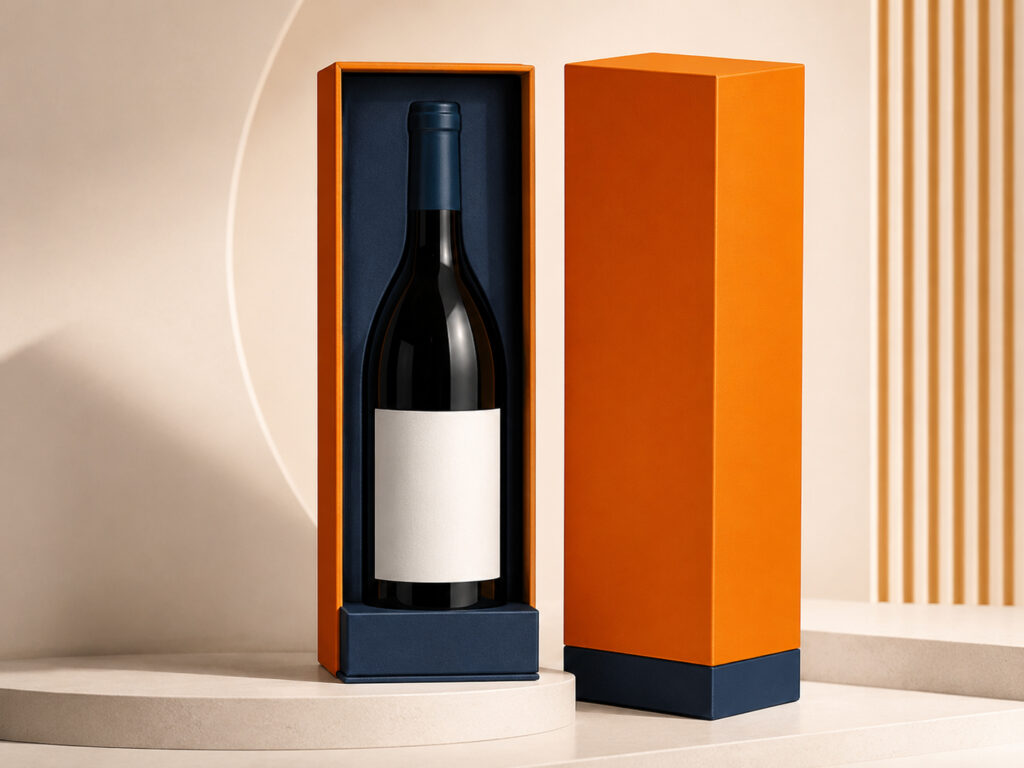
Open a good rigid box and the sequence feels deliberate. The lid resists slightly. The bottle appears cleanly. Nothing rattles. The insert doesn’t sag.
Open a bad one and you hear the bottle knock against the wall.
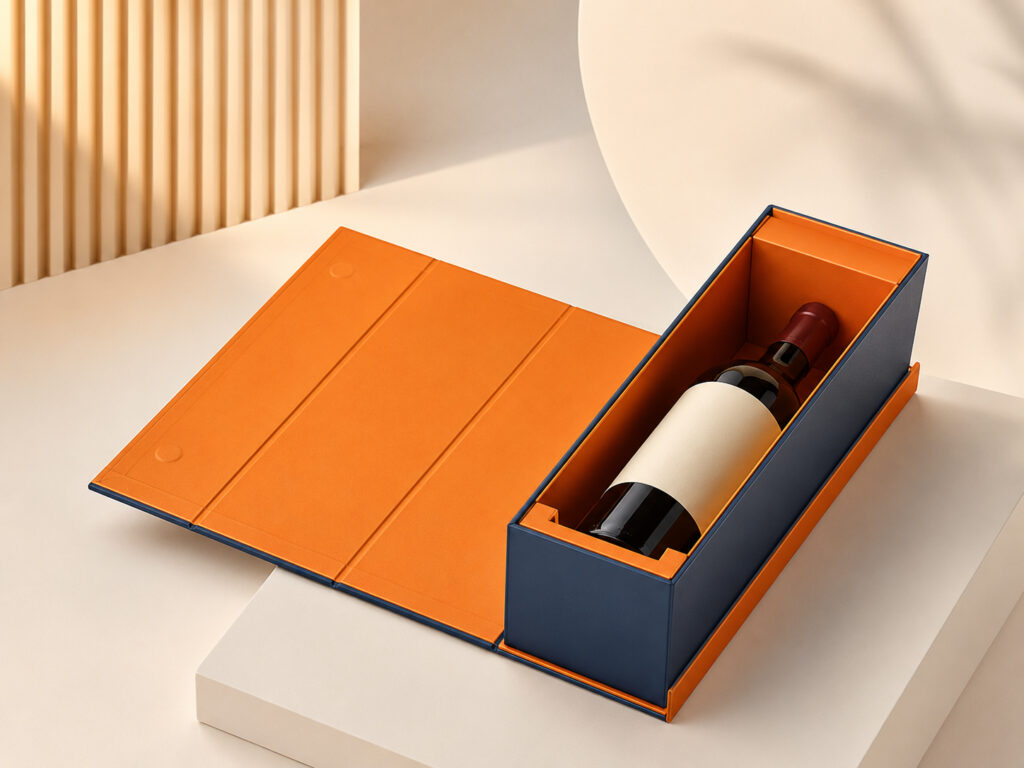
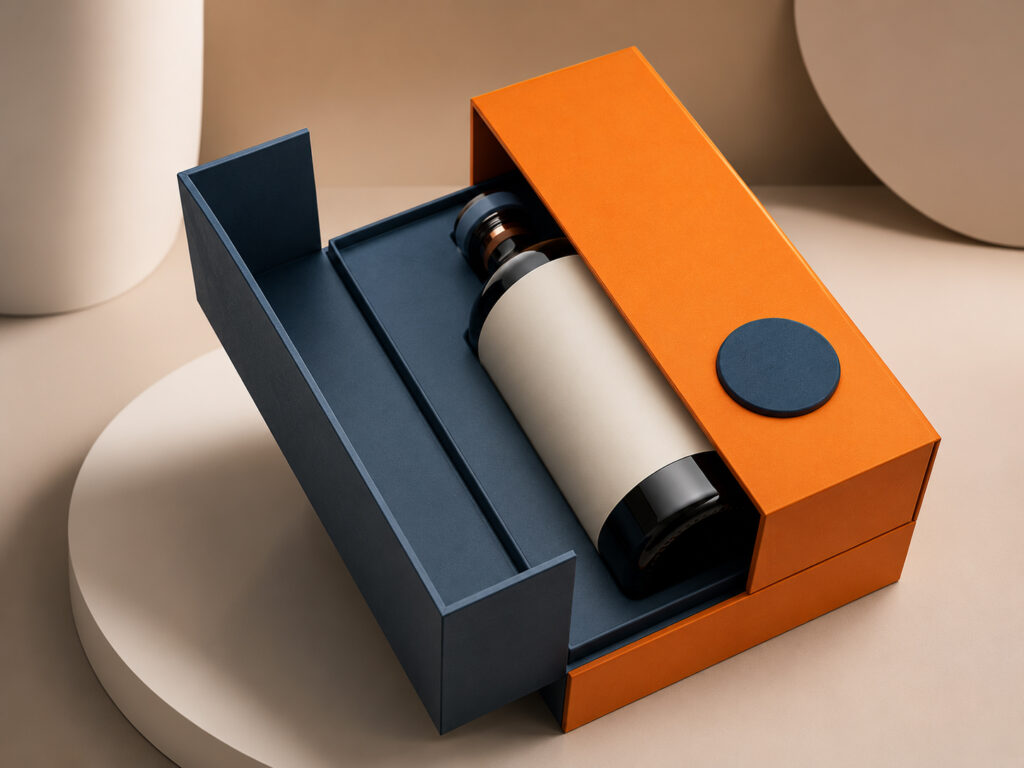
For premium programs, custom wine and spirits boxes may use book-style magnezztic structures, shoulder-neck boxes, lift-off lids, drawer formats or collapsible rigid constructions. Bottle wells, neck bridges, ribbon pulls, molded pulp cradles and paperboard platforms can be built into the pack.
But—here’s the ugly truth—many so-called luxury boxes are simply overbuilt.
Greyboard, two magnets, laminated EVA, polyester ribbon, plastic tray, metallic paper, hot foil, spot UV and soft-touch film all piled into one pack doesn’t automatically create value. Sometimes it creates a recycling problem with nice photography.
I frankly believe luxury lives in tolerances: clean corners, consistent reveal gaps, accurate registration, controlled opening force and an insert that fits the bottle without looking strangled.
Less noise. More control.
Custom Wine & Spirits Boxes
Cylindrical paper tubes
Paper tubes break the rectangular rhythm of the wine aisle. That visual difference alone can earn attention.
But a tube built for cosmetics can’t simply be enlarged for wine and declared finished. A filled bottle may weigh well over 1 kg, and during a drop that load drives straight toward the end cap.
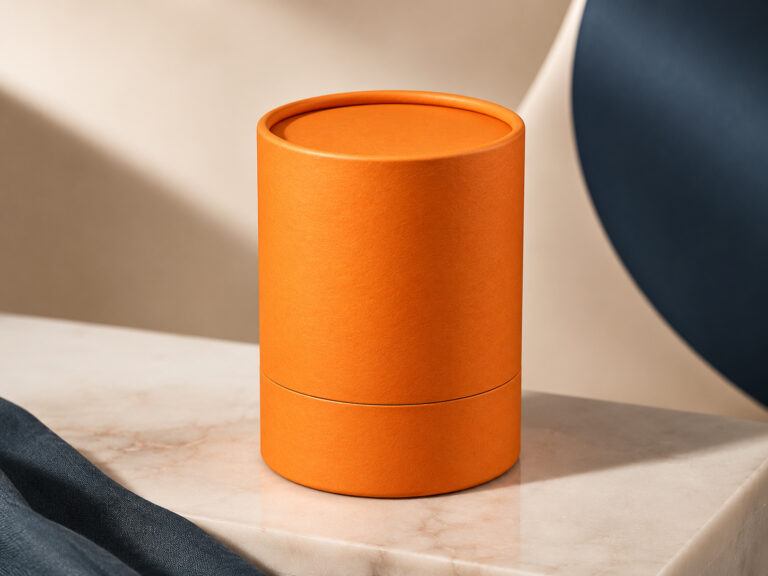
Although it serves another product category, a paper tube box with a fitted cap lid illustrates how a wound tube and cap can create a distinctive retail structure. For wine, the wall thickness, inner diameter, cap engagement, base retention and neck support must be recalculated around the actual bottle.
Headspace matters here. Too much and the bottle gathers speed before striking the base. Too little and the label scuffs during packing.
A few millimetres. Big consequences.
Wooden wine gift boxes and crates
Wood brings built-in associations: vineyards, cellars, barrels, collectors and craft.
That’s useful branding. It’s also why buyers sometimes forgive technical issues they’d reject immediately in paperboard.
Don’t.
Check wood species, moisture content, board thickness, sliding-lid clearance, splinters, nail placement, hinge strength, surface treatment and dimensional stability. Wood moves with humidity. A sliding lid that feels perfect in the sample room may bind after weeks in a damp warehouse.
Solid-wood packaging used internationally may also be subject to ISPM 15 phytosanitary rules. Plywood, engineered wood and thin processed components can be treated differently, depending on their construction and destination.
Rustic doesn’t mean regulation-free.
Corrugated Wine Shipping Boxes Do the Unfashionable Work
Nobody posts breathless unboxing videos about BC-flute export cartons. Pity. They often do more for customer satisfaction than the gift box inside.
Corrugated board combines liner sheets and a fluted medium. Terms such as E flute, B flute, C flute and BC double wall describe construction, but they don’t tell you the entire grade.
A single-bottle e-commerce mailer, six-bottle retail case and twelve-bottle export carton face different loads. Treating them as one design in three sizes is a shortcut I wouldn’t recommend.
Single-wall versus double-wall corrugated boxes
Single-wall corrugated board can perform well under controlled conditions, short routes and moderate loads. Double wall adds stiffness and puncture resistance, making it useful for export shipments, taller stacks and heavy cases.
Yet “double wall” isn’t a performance certificate.
Ask for the Edge Crush Test rating, liner and medium grammages, board caliper, Cobb water-absorption value, manufacturer’s joint specification and—where available—Box Compression Test data.
Then connect those values to reality:
Filled case weight
Bottles per case
Cases per pallet tier
Total stack height
Warehouse duration
Relative humidity
Hand-hole cut-outs
Transport mode
Last-mile handling
Tape or glue closure
Humidity is the sneaky one. A carton tested bone-dry can lose a meaningful amount of stacking strength after absorbing moisture.
Paper gets tired.
Corrugated dividers, air columns and suspension packs
Ever opened a case and found partitions leaning sideways while the bottles touch anyway? That divider organised the load. It didn’t protect it.
Traditional partitions reduce glass-to-glass contact. Folded end pads support heels and shoulders. Die-cut retention frames grip specific bottle profiles. Suspension systems hold the product away from the carton walls.
Inflatable air columns create separate cushioning chambers and can work very well. Then somebody underinflates them, punctures one during packing or changes the bottle diameter without revising the sleeve.
That happens.
Paper-based retention systems fit more naturally into fibre-recycling streams, though fit tolerance is unforgiving. If the bottle can travel before reaching the restraint, it has room to build momentum.
Packaging engineers call that free movement. Claims departments call it Tuesday.
Molded Pulp Wine Inserts Versus Foam
Molded pulp is often described as if the supplier pours wet paper into a bottle-shaped mould and the problem disappears.
Not so fast.
Draft angle affects tool release. Rib depth changes crush response. Drying can distort dimensions. Density affects stiffness. Narrow pads may concentrate force on the bottle instead of spreading it.
A proper molded pulp insert uses ribs, bridges, crush zones and support lands to control movement and absorb energy. It needs tolerances, not hope.
EVA and expanded polyethylene can create precise cavities, support heavy bottles and separate accessories cleanly. Black foam also makes almost any prototype look expensive, which is probably why people reach for it so quickly.
Still, foam can complicate recyclability claims and material separation. It may require cutting, laminating, adhesive bonding or new tooling.
My view? Begin with engineered paperboard or molded pulp when the protection target allows it. Move to foam when test results—or a genuinely difficult geometry—justify the move.
Use data. Not habit.
Regulations and Green Claims Nobody Should Improvise
Can the bottle size legally be sold? Does the label need a health warning? Is the closure compatible with the filling standard? Can the pack actually be recycled where customers live?
These questions belong near the beginning.
In the United States, wine containing 7% or more alcohol by volume is generally subject to federal wine-labelling rules and standards of fill. Products containing 0.5% ABV or more also require the government health warning. Brands should review current TTB wine packaging and labelling requirements before approving a new bottle size or printed label.
Europe is getting stricter too.
The 2024 European Parliament packaging agreement backed measures intended to reduce unnecessary packaging and make nearly all covered packaging recyclable under defined criteria.
That should make anybody planning a five-year packaging program pause. Oversized cavities, permanent mixed-material bonds and vague green language will face more scrutiny—not less.
And recycling statistics need careful handling. The EPA’s available national dataset estimated that 3.1 million tons of glass containers were recycled in 2018, equal to 31.3% of generated glass containers. Corrugated boxes reached an estimated 96.5% recycling rate in the same dataset.
Those are national figures. They don’t prove that a specific package will be recovered.
Coatings, adhesives, contamination, colour, consumer behaviour and local collection all change the outcome. A box that is technically recyclable may still be rejected by the system serving its buyer.
So don’t print “100% sustainable.” It means almost nothing.
Print something verifiable instead: 20% less glass by weight, FSC-certified paper, a molded fibre insert replacing EVA, no plastic lamination, or a specified percentage of post-consumer fibre.
Specific beats green.
How to Choose Wine Packaging Without Fooling Yourself
Start with the route—not the mood board
Where does the wine go after packing?
Cellar-door sales, supermarket shelves, restaurants, airport shops, e-commerce subscriptions, wholesale pallets and corporate gift programs create different failure modes.
A retail gift box may only need to survive case distribution. A direct-to-consumer pack might face conveyors, repeated drops, rain, vibration and a final throw onto somebody’s doorstep.
Design for the real route. Preferably the worst credible route.
Custom Wine & Spirits Boxes
Measure the physical bottle
“Standard 750 mL bottle” isn’t enough.
Record overall height, maximum diameter, shoulder angle, heel radius, base shape, closure height, filled weight, centre of gravity and dimensional tolerances. Provide actual production bottles if possible.
Bordeaux, Burgundy, Rhône, Alsace and Champagne bottles occupy different envelopes. Proprietary bottles wander even further off-script.
A photo beside a ruler starts a conversation. It shouldn’t start tooling.
Define the test target
“Shipping safe” sounds reassuring. It specifies nothing.
Write down the drop height, drop faces and corners, sample quantity, conditioning environment, vibration duration, compression load and pass criteria. Decide whether a scuffed label passes. Decide whether slight box deformation passes.
ISTA 3A may be relevant for parcel delivery, but distribution systems differ. Test the complete filled pack: bottle, closure, label, insert, gift box, outer carton and sealing method.
All of it.
Calculate landed cost
The unit price is the number everyone sees. It may be the least interesting number.
A collapsible rigid box may cost more per unit and still produce a lower landed cost than a fully assembled setup box. A wooden case may look wonderful and punish the airfreight budget.
Cheap boxes can be expensive.
Match packaging to positioning
Premium doesn’t always mean heavy. Sustainable doesn’t automatically mean brown kraft. Modern doesn’t automatically mean PET.
And more components don’t create more value.
A disciplined uncoated box—with tight corner wrapping, sharp type and a bottle-specific pulp insert—can look more credible than an oversized magnetic structure drowning in soft-touch film, foam and gold foil.
I’d choose coherence every time.
Test the blank sample first
Before approving decoration, make a white structural sample.
Load the bottle. Tilt it. Invert it. Shake it. Check label scuffing, neck clearance, finger access, insert collapse, cap engagement and opening force.
Then drop it.
If the team spends two meetings choosing foil but hasn’t tested the structure, the priorities are upside down. Decoration can hide bad engineering just long enough to reach mass production.
That’s when it gets expensive.
FAQs
What are the main types of wine packaging?
The main wine packaging types are glass and PET bottles, aluminium cans, bag-in-box systems, flexible pouches, aseptic cartons, folding cartons, rigid gift boxes, paper tubes, wooden crates, corrugated shipping cases, molded pulp inserts, and foam supports, each serving containment, presentation, protection, distribution, or a combination of these functions.
Glass remains familiar for retail and cellaring. PET, cans, pouches and bag-in-box formats lean toward lower weight, portability or portion control. Corrugated cartons and inserts handle transit protection.
What is the best packaging for shipping wine bottles?
The best packaging for shipping wine bottles is a tested system combining a dimensionally correct insert, a corrugated outer carton, secure closure, controlled empty space, and board strength matched to bottle weight, route, stack height, humidity, and carrier handling rather than a generic box selected by appearance.
Single-bottle mailers may use molded pulp end caps, suspension systems or folded corrugated retainers. Multipacks require reliable partitions, compression strength and stable palletisation.
Are corrugated wine boxes suitable for international shipping?
Corrugated wine boxes are suitable for international shipping when their board grade, joint construction, moisture resistance, internal partitions, pallet pattern, compression strength, and closure method have been validated against the actual bottle load and expected sea, air, road, warehouse, and last-mile conditions.
Humidity deserves special attention. Sea freight and damp storage can reduce corrugated stacking strength, so dry-lab data alone may be misleading.
Are molded pulp wine inserts better than foam inserts?
Molded pulp wine inserts are generally better for paper-led material strategies and shaped cushioning, while foam inserts may provide tighter tolerances, cleaner cut cavities, or stronger support for unusually heavy products; the correct choice depends on test performance, product weight, presentation requirements, local recovery systems, tooling budget, and assembly method.
Neither material wins by name alone. Geometry, tolerance and actual impact testing decide the result.
What packaging is best for premium wine gifts?
The best packaging for premium wine gifts is a rigid paperboard, wooden, or cylindrical tube structure fitted with a bottle-specific insert, because these formats provide controlled presentation, sufficient branding area, and a deliberate unboxing sequence while protecting the bottle from movement and contact damage.
Accessories need restraint too. A loose corkscrew or glass inside a gift box can become a very effective damage tool during transit.
Is bag-in-box wine more sustainable than bottled wine?
Bag-in-box wine can use substantially less packaging weight per litre and improve pallet and transport efficiency compared with multiple heavy glass bottles, but its overall environmental performance depends on bag composition, tap design, recycled content, wine waste, distribution distance, local collection systems, and whether consumers separate the paperboard shell.
It may also reduce waste after opening. Still, lower packaging weight doesn’t make every flexible barrier film easy to recycle.
How should a brand choose between glass, PET and aluminium?
A brand should choose between glass, PET, and aluminium by comparing shelf-life needs, oxygen and light barriers, filling-line compatibility, closure systems, container weight, breakage risk, serving size, sales channel, consumer expectations, food-contact compliance, recycling infrastructure, freight efficiency, and the intended price position of the wine.
Glass suits traditional retail and longer storage. PET works for lightweight, faster-turnover programs. Aluminium fits portable single servings after liner and seam validation.
What information does a packaging supplier need for a wine box quotation?
A wine packaging supplier needs the bottle dimensions and filled weight, quantity, destination, sales channel, preferred structure, materials, printing colours, finishes, insert type, accessories, test standard, packing method, artwork status, target delivery date, and whether the quoted price must include tooling, assembly, export cartons, freight, or delivered-duty costs.
Physical bottle samples reduce uncertainty. Accurate CAD files help too. Guessing from photographs doesn’t.
How can wine packaging damage be reduced?
Wine packaging damage can be reduced by eliminating uncontrolled bottle movement, separating glass surfaces, supporting the neck and base, selecting suitable corrugated strength, controlling headspace, reinforcing vulnerable seams, conditioning samples for realistic humidity, and testing the complete filled pack through drops, vibration, compression, and handling simulations before mass production.
After launch, track failures by bottle, route, carrier and season. An overall claim rate can hide one badly performing SKU.
Can luxury wine packaging also be recyclable?
Luxury wine packaging can be recyclable when it uses a restrained number of compatible materials, avoids unnecessary lamination and permanent mixed-material attachments, allows inserts and accessories to be separated, carries accurate disposal instructions, and still meets protection requirements without relying on oversized structures or decorative components that obstruct material recovery.
Good paper, tight reveals and precise wrapping can look luxurious. Packaging doesn’t need magnets, foam, ribbon, film and metal hardware all at once.
Build Wine Packaging Around the Bottle, Route and Buyer
Good wine packaging protects the bottle, supports the brand and survives the unglamorous details—packing labour, freight, storage, regulation, humidity, recycling and careless handling.
Miss one and the job isn’t finished.
If you’re developing a wine gift box, subscription mailer, molded pulp insert, paper tube, wooden presentation case or multi-bottle shipping carton, provide Chengyi Packaging with the bottle dimensions, filled weight, order quantity, destination market, sales channel and target delivery date.
Request a custom wine packaging quotation to discuss structure, materials, inserts, printing, finishes, structural samples, testing requirements, MOQ and production lead time.